Video is one of my favorite mediums for UX research storytelling.
Video stories connect your audiences to the source material. The human voices, an epiphany dawning on someone, the physical environment they occupy in their daily lives, the objects they use, the stories they choose to tell (and sometimes the long silences) — all these give texture to the human experience that our products are being designed for.
Video invites viewers to encounter more stimuli before the data gets filtered into a set of insights by a researcher. This connects viewers to their own feelings, perhaps the most powerful source of creativity.
I want to share three UX research scenarios where I turned to video storytelling. I hope it inspires researchers to experiment more with this medium, and not to be afraid of stepping away from the research report deliverable.
The global moment
There was that time when Covid had first hit. This was when cities were first issuing evening curfews and encouraging social distancing. The shock, anxiety, and helplessness could be felt across the world.
My research partner and I decided to tell the human stories of Covid’s impact. We were in the throes of analyzing diary study data we had collected for a research study, but a report with insights didn’t feel enough to meet the all-consuming nature of this global moment.
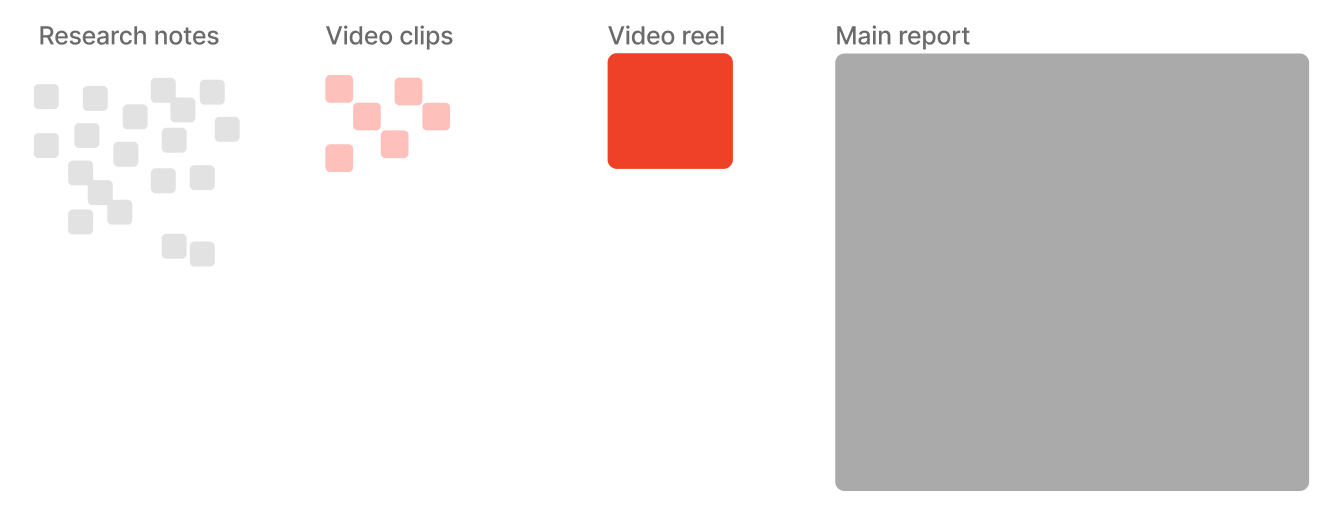
What resulted was the creation of “Coping with Covid”, a 5-minute video reel featuring the most resonant video clips from our data. We broadcasted it remotely during a company-wide meeting for thousands of employees, virtually, during a time when every one was acclimating to this new normal and dialing in from their homes.
We could have delivered insights about the 3 most prevalent Covid-related concerns. Our research report had plenty of these, as well as numbers, charts, quotes… and the charts were spliced by multiple geographic markets, and demographic groups too (an audience favorite).
But that wouldn’t be as compelling as selfie videos featuring the following (paraphrased):
“The weekend after Covid hit, I had my fourth baby. And then I had to homeschool my 5 year old while having a newborn in the house. I haven’t had any family come visit to see the new baby.”
“Because of Covid, I had to move to a new apartment since my housemates worked in healthcare. I was at risk since I’m asthmatic.”
“I have the kids full-time and no babysitters or help. No playdates, museums, aquariums. It’s hard to tell my toddler we can’t see his grandparents.”
“I have a dog walking business and I nanny on the side. My income is all gone now because people are staying home. We were in the process of buying a home, but have to put that on hold now.”
“I’m a singer making most of my money from live shows. These have all been canceled, so I’ve just been applying for financial assistance.”
These user stories touched upon a raw space within. “Coping with Covid” conveyed the universal struggle we all face — that felt sense of uncertainty, deprivation, and yearning for something to get better quickly. The impact of this video wasn’t measured in the tangible impact it had on specific product decision, but rather in the way it created an emotional bridge between the employees at our company and the people, our users, we served. It helped us grasp the significant of the moment, and how we could play a role in people’s lives.
Like hanging out after school
There was a time when I screwed up before my research interviews even started. My partnership with my participant recruiter had broken down.
Let’s just say I didn’t meet my minimum number of participants. I was getting all my research interviews scheduled at the very last minute. It was not enough time to invite my stakeholders to attend these sessions (usually, stakeholder engagement is one of my top priorities when conducting research). I also discovered midway that my product team’s development timelines had shifted, and I would not be able to find the necessary time to complete my recruitment and also make time for synthesis and reporting the findings.
But the three participants I was able to interview turned out to be excellent recruits, and they couldn’t be more different. Their stories touched me, intrigued me, and made me laugh.
The research topic was ‘content creation’, but these creators spoke to universal themes of the fragility of life, the disorientation of instant fame, the self consciousness of being judged by strangers on social media, the status debate between size of influence and having a college degree, and the healing power of online communities.
They had powerful stories, stories that I wanted to tell. Stories that could inspire.
So I abandoned what was once a research study, and pivoted this into a Viewing Event. I dropped the expectation of having answers to a set of questions, and replaced these with provocations that could get my team reflecting on the deeper meaning of our topic: why people create content online.
Here’s what I did. I had 3 hourlong video recordings of my interviews. I edited each of these down to 8 minutes (this took me a lot more time than I initially thought it would). I added in select footage of their social media content that helped showcase what they were describing in the interviews. These three edited video clips became the stimulus of a Viewing Event I hosted for my product team.

We gathered for an hour, and I facilitated a showing of each person’s story, followed by a discussion. Each video anchored us on the lived experience of one content creator, and the discussion afterward invited people to draw upon their broader experiences — a recent experience a team member had, an article someone had read, one person’s relative who was going through a similar health scare, and another person’s telling of how they tried to create content but failed.
These discussions felt like hanging out with your friends afterschool. There were no stakes, no quotas for productivity, no deadline for next steps. It was a space to observe, listen, and share. We were making meaning of the topic together. Some of the best ideas often come out when people feel relaxed and not under pressure to perform.
These conversational strands serve a vital purpose: they become ingrained in our subconscious and eventually form into what we often refer to as ‘intuition’. They kindle new concepts and provide us with instincts about what is likely to be successful, and what isn’t. Feeding ourselves with curiosity, dialogue, and real human stories enhance our abilities to create better things.
Inspiring a vision workshop
There was that time we suddenly needed to organize a vision workshop. For one day, team members across orgs cleared their calendars to gather together. We would spend that day understanding the problem space and brainstorming, with permission to go broad.
Our topic: creator-centered communities.
As the research lead, I volunteered to present something. While I had plenty of past research insights that could be repurposed, I didn’t want to be talking at this group for an hour. And my past findings didn’t feel like the most inspiring stimulus for this vision workshop. Many of my closer team members had heard my talking points ad nauseum, so there wouldn’t be much novelty forthem. And I wanted to start at a blank slate, rather than anchor our understanding based on the specific folks we studied in the past.
So I turned again to video.
My aim was to explore the various manifestations of “Creator-centered communities”. To achieve this, I launched multiple unmoderated studies on usertesting.com to cast a wide net. I then handpicked three compelling narratives (three seems to be some sort of magic number for me), and created three videos by splicing together the most interesting parts of the participants’ original video data. I accomplished all of this within usertesting.com and within the span of a week (I was relieved to discover that video storytelling doesn’t always have to take a long time!).
On vision workshop day, I played these videos for the broader group, offering the material as inputs for whatever people wanted to make of it. People selected the elements they wanted to pay attention to, filtered out the rest, and decided for themselves what would be useful. I didn’t have an agenda to deliver a particular insight. My goal was to inspire creativity.
Even with just three stories, the audience had a lot of material to work with. We met a member of an online gamer’s livestream community, a fan who paid for access to her favorite YouTuber’s private online community, and a K Pop boy band devotee who was on a mission to help other fans’ dance tribute videos go viral. Each person had shared their screen, showing how they utilized their online creator community platforms (one on Twitch, one on Patreon, and one on Tik Tok).
Through these stories, we could explore many themes: why people join creator communities, intimacy with a chosen creator, roles and responsibilities, financial incentives, power dynamics, rewards systems, membership boundaries, group identity, and the list goes on. These themes became lines of exploration for our own vision.
After we watched these, we reflected upon the pieces in their stories that resonated, and those that we wanted to stay far away from as we designed our own vision.
The only skills that matter
It’s not easy making great video stories, but it is easy to get started.
You don’t always need to be an expert wielding all the knowledge on your subject, because you won’t ever get there. Even just one story, told at the right time to the right audience can change the direction the ship is sailing. It’s because human stories can tap into a universal knowing, breathing life into something meaningful by surpassing the logical mind .
It’s okay if you don’t have the technical skills to edit videos. You can leverage basic video editing tools built into research software nowadays by writing down timestamps and clicking a few buttons. You can start with a basic editing program like iMovie or any number of mobile video apps nowadays… Or outsource the task to freelancers living in the opposite end of the world from you.
The skills you do need, which can be developed with practice, are an eye for story and a sense of pacing. Don’t be afraid to treat video storytelling as an art, not a science.
Most importantly, you need to be connected to the feelings that emerge, before judgment kicks in, when you’re collecting your data. Pay attention to your knee jerk reaction, the instinctual tug, the heaviness in your chest, the quickening of your breath — these are the seeds of what might be a great story waiting to be told.
Here are a few of my favorite documentaries that tell human stories:
- Found — the story of three Chinese cousins who were adopted by three different American families. They find each other as teenagers through 23andMe and explore the meaning of family, identity, and culture.
- Free Solo — the story of rock climber Alex Honnold as he prepares for the dangerous feat of scaling Yosemite’s El Capitan… without a rope. Directed by Alex’s friends, this film does an excellent job capturing the motivations, hopes, and fears driving someone who’d risk his life to achieve a lifelong dream.
- Amanda Knox — the story of what happened when Amanda Knox was convicted of murdering her roommate when she had studied abroad in 2007. What intrigued me most was that the story was told through multiple perspectives — including Amanda herself, the journalist, the prosecutor, and the ex boyfriend — each with their own goals.
- The Last Dance — the story of Michael Jordan’s career with the Chicago Bulls, and the ensuing rise of the NBA to the global cultural stage. Every episode brought forth a storyline that focused on a key individual in Michael’s story, weaving in mini-stories about his teammates Scottie Pippen and Dennis Rodman, the team owner Jerry Krause, coach Phil Jackson, Michael’s father, and some of his greatest rivals. The storytelling made each of these supporting characters just as interesting as Michael.
 reflections of a ux researcher
Leave a comment